
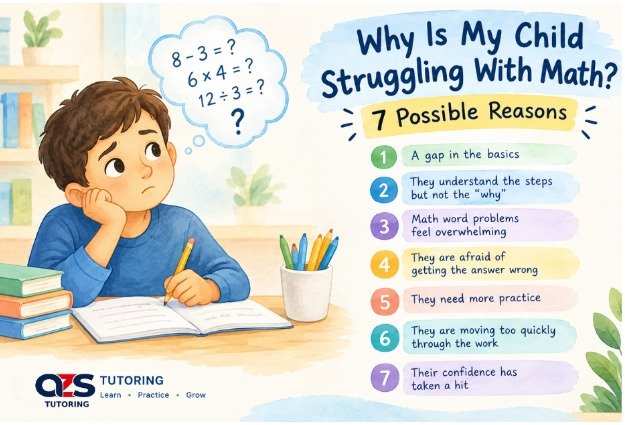
Why Is My Child Struggling With Math? 7 Possible Reasons and How to Help
Helping your child with math homework can sometimes feel frustrating. You explain a problem, demonstrate the steps, and even work through an example together. Yet, when your child tries a similar question independently, they may still feel confused.
Perhaps your child once enjoyed math but has started avoiding homework. Maybe they can solve simple calculations but struggle with word problems, fractions, multiplication, or multi-step questions. You may even hear them say, “I’m just bad at math.”
If this sounds familiar, you might be asking yourself: Why is my child struggling with math, and what can I do to help?
Math difficulties can happen for several reasons. Your child may have gaps in foundational skills, struggle to understand mathematical concepts, need more practice, or feel anxious about making mistakes. Sometimes, they understand the lesson but rush through their work and overlook important details.
The important thing to remember is that struggling with math does not mean your child cannot improve. With patience, targeted practice, and the right learning support, children can strengthen their math skills and develop greater confidence.
In this guide, we will explore seven common reasons children struggle with math and practical ways parents can support their learning at home.
1. Your Child Has Gaps in Basic Math Skills
One of the most common reasons a child struggles with math is a weak foundation in earlier concepts.
Math skills build on one another. Children often need to understand basic number concepts before they can confidently solve more advanced problems. When an essential skill has not been fully understood, new lessons can become increasingly difficult.
For example, a child who struggles with addition and subtraction may find multiplication more challenging. Similarly, difficulty with multiplication can make division, fractions, and more complex calculations harder to understand.
How Missing Math Foundations Affect Learning
Sometimes, the problem is not the current lesson. Your child may be struggling because an earlier concept was never fully understood.
Imagine building a house on an unstable foundation. Even if you continue adding new parts, the original weakness remains.
The same principle applies to mathematics. Moving to advanced topics without understanding the basics can create additional learning difficulties.
Signs Your Child May Need Foundational Math Help
Look for patterns such as:
- Difficulty with addition, subtraction, multiplication, or division.
- Repeated mistakes when solving similar problems.
- Trouble understanding place value or number relationships.
- Difficulty solving problems that combine several basic skills.
- Uncertainty about common mathematical terms and instructions.
How Parents Can Help
Instead of immediately moving to more difficult exercises, revisit the concepts your child finds challenging.
Try these strategies:
- Practice basic calculations using simple examples.
- Use objects, drawings, or number lines to explain abstract ideas.
- Ask your child to solve an easier version of the same problem.
- Review previous lessons before introducing a new topic.
- Encourage questions whenever something is unclear.
Identifying and addressing these learning gaps can help your child approach new math lessons with greater confidence.
2. Your Child Memorizes Math Steps Without Understanding the Concepts
Another reason children struggle with math is that they learn how to follow a procedure without understanding why it works.
A child might memorize the steps for solving a multiplication problem and get the correct answer during practice. However, when the question is presented differently, they may not know which method to use.
This often happens when learning focuses only on getting the correct answer rather than understanding the underlying concept.
Why Understanding Math Concepts Matters
Mathematics requires more than memorizing formulas and procedures. Children also need to recognize patterns, understand number relationships, and apply what they learn to different situations.
For example, a student may know how to multiply two numbers but struggle when multiplication appears in a word problem.
The challenge is not necessarily the calculation itself. The student may not recognize that multiplication is the appropriate operation.
Encourage Your Child to Explain Their Thinking
Instead of asking only, “What is the answer?” try asking questions that encourage reasoning.
Questions Parents Can Ask
- How did you get this answer?
- Why did you choose addition, subtraction, multiplication, or division?
- Can you explain the steps in your own words?
- Can you solve the same problem using another method?
- How can you check whether your answer makes sense?
These questions help you understand how your child approaches a problem and where they may need additional guidance.
The goal is not simply to complete the homework. It is to help your child understand mathematical concepts well enough to apply them independently.
3. Math Word Problems Feel Overwhelming
Some children can perform basic calculations correctly but struggle when the same calculations appear in written questions.
If your child finds math word problems difficult, the challenge may involve reading comprehension, identifying relevant information, understanding what the question asks, or choosing the correct mathematical operation.
Why Are Math Word Problems Difficult for Children?
A word problem requires several skills at the same time. Children must read the question, understand the situation, identify important details, select a suitable operation, perform the calculation, and check the result.
For a student who is still developing reading and problem-solving skills, managing all these steps can feel overwhelming.
For example, a child may understand subtraction perfectly well but become confused when asked to calculate how many apples remain after some are given away.
How to Help a Child Solve Math Word Problems
Teach your child to break a large problem into smaller, manageable steps.
A Simple Step-by-Step Problem-Solving Method
Step 1: Read the question carefully. Help your child understand what is happening in the problem.
Step 2: Identify the important information. Find the numbers and details needed to solve it.
Step 3: Understand what needs to be found. Ask your child to explain the question in their own words.
Step 4: Choose the appropriate operation. Decide whether addition, subtraction, multiplication, division, or another method is needed.
Step 5: Solve and check. Complete the calculation and determine whether the answer makes sense.
Helpful Questions to Ask
- What information do we already know?
- What are we trying to find?
- Which details are important?
- What mathematical operation could help?
- Does the final answer make sense?
With regular guidance, children can learn to approach word problems more systematically instead of guessing which operation to use.
4. Your Child Is Afraid of Making Math Mistakes
Sometimes, the biggest obstacle to learning math is not the subject itself. It is the fear of getting an answer wrong.
When children experience repeated difficulties, they may become nervous whenever they see a math worksheet or encounter an unfamiliar problem. They may erase their work repeatedly, hesitate to answer questions, or avoid attempting problems they think are too difficult.
Over time, this fear can interfere with their willingness to practice and learn.
How Math Anxiety Can Affect Learning
A child who worries about making mistakes may spend more time thinking about failure than concentrating on the problem.
They might say:
- “I can’t do this.”
- “I’m always wrong.”
- “I’m bad at math.”
- “Everyone else understands except me.”
These statements can indicate that your child needs encouragement and a more supportive learning experience.
Help Your Child Feel Comfortable Making Mistakes
Instead of immediately correcting an incorrect answer, try to understand how your child arrived at it.
For example, ask, “Let’s look at your steps together. Can you show me how you worked it out?”
This approach helps you identify whether your child misunderstood the concept, selected the wrong operation, or made a simple calculation error.
Create a Positive Math Learning Environment
You can support your child by:
- Praising effort, persistence, and problem-solving.
- Treating mistakes as opportunities to learn.
- Avoiding comparisons with siblings or classmates.
- Breaking difficult problems into smaller steps.
- Celebrating improvements, even when they seem small.
Children do not need to answer every question correctly to become better at math. They need opportunities to learn, practice, and try again without feeling discouraged.
5. Your Child Needs More Practice With Math Skills
Understanding a concept during a lesson does not always mean a child has mastered it.
Children often need repeated opportunities to practice a skill, apply it in different situations, and recall it independently. A student might solve multiplication problems correctly with guidance but struggle when working alone the following day.
This does not automatically mean the child was inattentive. They may need additional practice to become more comfortable with the concept.
How Regular Math Practice Supports Learning
Consistent practice can help children strengthen their understanding, recognize familiar problem patterns, and become more confident when solving questions independently.
However, effective practice does not have to involve completing long worksheets every evening.
Make Math Practice Part of Everyday Life
Parents can introduce simple math activities during ordinary daily routines.
Everyday Activities That Build Math Skills
- Cooking: Measure ingredients and discuss quantities.
- Shopping: Compare prices and calculate the total cost.
- Money: Count coins, add amounts, and calculate change.
- Time: Read clocks and calculate how much time has passed.
- Measurement: Measure objects around the house.
- Games: Use puzzles, cards, and age-appropriate math games.
- Mental math: Ask short questions involving everyday calculations.
Keep practice appropriate to your child’s current ability and introduce more challenging questions gradually.
Short, focused practice sessions can help children improve without making math feel like a constant source of frustration.
6. Your Child Rushes Through Math Homework
Not every child who struggles with math has difficulty understanding the concepts. Some children know how to solve a problem but make avoidable mistakes because they work too quickly.
They may skip steps, copy numbers incorrectly, overlook mathematical signs, or forget to check their answers.
Common Signs of Rushing Through Math Work
Watch for these patterns:
- Misreading the question.
- Confusing addition and subtraction signs.
- Copying numbers incorrectly.
- Skipping important calculation steps.
- Making simple errors in otherwise familiar problems.
- Finishing quickly without reviewing the answers.
If these mistakes occur frequently, encourage your child to develop a more careful problem-solving routine.
Teach the Read, Think, Solve, and Check Method
A simple routine can help children approach their work more thoughtfully.
1. Read
Read the entire question and identify what it asks.
2. Think
Decide which information is important and which steps are needed.
3. Solve
Work through the calculation carefully and show the necessary steps.
4. Check
Review the calculation, signs, and final answer. Ask whether the result is reasonable.
Encourage your child to use this routine consistently. The purpose is not to make homework unnecessarily slow but to develop accuracy and independent problem-solving habits.
7. Your Child Has Lost Confidence in Math
Repeated difficulties can affect how children see themselves as learners.
A child who struggles with several lessons may begin believing that math is simply something they cannot understand. They may compare themselves with classmates, avoid challenging questions, or give up before making an attempt.
This loss of confidence can make existing learning difficulties feel even more challenging.
Why Math Confidence Matters
Children who believe they cannot succeed may be less willing to practice, ask questions, or attempt unfamiliar problems.
That is why parents should pay attention not only to correct answers but also to a child’s attitude toward learning.
Help Your Child Build a Growth Mindset
A growth mindset encourages children to recognize that their skills can improve through learning, practice, and effort.
Instead of saying only, “You’re good at math,” try acknowledging the specific actions that helped your child make progress.
Encourage Progress With Positive Feedback
You might say:
- “You kept trying even when that question was difficult.”
- “You found your mistake and corrected it.”
- “You understand this step better than you did yesterday.”
- “Let’s try another method together.”
- “You don’t need to know everything immediately.”
Avoid expecting instant improvement. Give your child time to understand difficult concepts and recognize the progress they make along the way.
Confidence does not mean every problem will be easy. It means your child feels capable of learning how to solve it.
What Should You Do If Your Child Is Struggling With Math?
If you are wondering how to help a child struggling with math, start by identifying the specific difficulty rather than assuming that more homework is always the solution.
Every child learns differently. Some need to revisit foundational concepts, while others benefit from clearer explanations, structured practice, or additional support with problem-solving.
Identify the Area Where Your Child Needs Help
Start by observing which types of questions cause the most difficulty.
Your child may need help with:
- Basic number skills and arithmetic.
- Addition, subtraction, multiplication, or division.
- Fractions, decimals, or other grade-level topics.
- Understanding math word problems.
- Following multi-step instructions.
- Applying mathematical concepts independently.
- Checking calculations and avoiding careless mistakes.
- Building confidence and maintaining motivation.
Once you identify the problem area, you can focus practice on the skills your child needs to strengthen.
Use a Consistent and Supportive Learning Routine
Try setting aside a short, regular period for math practice. Review previous concepts, work through examples together, and gradually encourage your child to solve similar questions independently.
Keep the learning environment calm and allow your child to ask questions without feeling embarrassed.
Remember that the goal is not to turn every evening into a stressful math lesson. It is to make learning more manageable and help your child develop skills over time.
When Should You Consider Math Tutoring for Your Child?
Extra academic support may be helpful when a child continues to struggle despite regular practice or needs more individual attention than they currently receive.
You may want to consider math tutoring if your child:
- Frequently struggles to understand grade-level math lessons.
- Has persistent gaps in foundational math skills.
- Finds it difficult to solve problems independently.
- Becomes increasingly frustrated with math homework.
- Has difficulty keeping up with classroom assignments.
- Needs additional practice and personalized explanations.
- Has lost confidence in their ability to learn math.
How Math Tutoring Can Help
A supportive tutor can help identify learning gaps, explain challenging concepts in different ways, and provide structured opportunities to practice.
Benefits of Personalized Math Support
Focused learning: Lessons can concentrate on the specific topics your child finds difficult.
Clear explanations: Difficult concepts can be broken down into smaller, easier-to-understand steps.
Guided practice: Students can work through examples and receive feedback as they learn.
Improved confidence: A supportive environment can encourage children to ask questions and try unfamiliar problems.
Stronger problem-solving skills: Students can learn to understand questions, select appropriate methods, and check their work.
The goal of math tutoring is not simply to complete homework. It is to help children understand what they are learning and gradually become more independent, capable learners.
How AZS Tutoring Can Help Your Child With Math
At AZS Tutoring, we understand that every child has different learning needs, strengths, and challenges. When a student struggles with math, the right support can help make difficult concepts easier to understand and practice.
Our online tutoring services are designed to support students as they strengthen academic skills, work through challenging topics, and develop confidence in their learning.
Online Tutoring Support for Different Learning Needs
AZS Tutoring offers academic support in the following areas:
- Math for Grades K–5
- English for Grades K–5
- Science for Grades K–5
- Mathematics for Grades K–12
Whether your child needs help understanding a particular math concept, practicing grade-level skills, or developing stronger problem-solving habits, additional learning support can help make the process more manageable.
Give Your Child the Support They Need
You do not have to wait until math difficulties become overwhelming before exploring additional support.
Start by identifying your child’s challenges, encouraging questions, and creating opportunities for consistent practice. When more guidance is needed, consider tutoring that focuses on your child’s individual learning needs.
Visit AZS Tutoring to learn more about our tutoring services.
For inquiries, email inquiry@azsimplesolution.com.
Final Thoughts: Every Child Can Make Progress in Math
If you have been asking, “Why is my child struggling with math?”, remember that there may be several reasons behind the difficulty.
Your child might need to strengthen basic skills, understand concepts more deeply, practice word problems, slow down during homework, or rebuild confidence after repeated mistakes.
The first step is to identify what is making math difficult. From there, you can provide focused practice, encouragement, and additional learning support when needed.
Celebrate small improvements, give your child time to learn, and remind them that making mistakes is part of the learning process.
With patience, consistent practice, and appropriate support, children can strengthen their math skills and become more confident problem-solvers—one step at a time.