How to Teach Kids to Write a Paragraph: A Step-by-Step Guide
Writing a paragraph is one of the most important milestones in a child’s early education. It helps children organize their thoughts, express ideas clearly, and develop essential communication skills. However, many young learners find paragraph writing challenging. They may struggle to think of ideas, connect sentences, or understand how to begin and end their writing.
The good news is that paragraph writing is a skill that children can develop with consistent practice and the right guidance. By introducing a simple structure, providing engaging topics, and encouraging creativity, parents can help children become more confident writers.
Whether your child is in kindergarten, 1st grade, 2nd grade, or 3rd grade, these practical strategies can make learning to write paragraphs easier and more enjoyable.
What Is a Paragraph?
A paragraph is a group of related sentences that explain one main idea. Every sentence should contribute something meaningful to the topic.
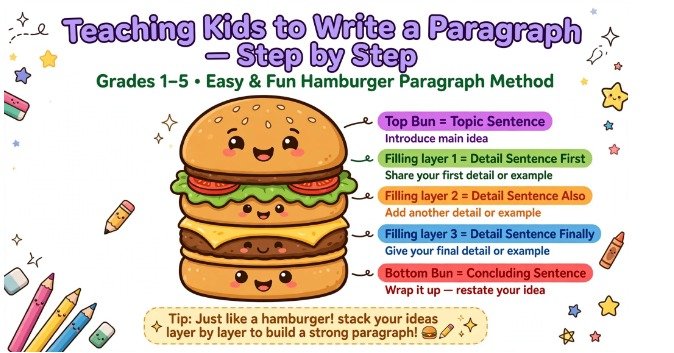
One easy way to teach paragraph writing is through the hamburger paragraph method. This visual approach helps children understand the three main parts of a paragraph:
- Top Bun – Topic Sentence: Introduces the main idea.
- Filling – Supporting Details: Provides facts, examples, and explanations.
- Bottom Bun – Concluding Sentence: Brings the paragraph to a natural ending.
This simple comparison makes paragraph structure easier for young learners to understand and remember.
Step-by-Step Guide to Teaching Kids Paragraph Writing
Step 1: Choose a Topic Your Child Enjoys
Children are more likely to enjoy writing when they are interested in the topic. Instead of starting with difficult or unfamiliar subjects, choose something they already know and love.
For example:
- My Favorite Animal
- My Best Friend
- My Favorite Game
- A Memorable Family Trip
- My Favorite Season
- If I Could Have a Superpower
Helpful Tip: Ask your child a few questions about the topic before writing. A short conversation can help generate ideas and make writing less intimidating.
Step 2: Plan Ideas Before Writing
Planning is an important part of the writing process. Before asking children to write complete sentences, help them organize their thoughts.
A simple graphic organizer can make this activity easier:
- Write the main topic inside a circle.
- Draw three lines extending from the circle.
- Add one supporting idea to each line.
- Encourage your child to explain each idea in their own words.
Younger children can draw pictures instead of writing complete ideas. This allows them to connect their thoughts with words gradually.
Step 3: Write a Clear Topic Sentence
The topic sentence introduces the main idea of the paragraph. It tells readers what they are going to learn about.
For example:
“Dogs make wonderful pets.”
This sentence clearly introduces the topic and gives children a direction for the rest of their writing.
If your child needs additional support, provide simple sentence starters:
- My favorite ______ is ______.
- I enjoy ______ because ______.
- There are three reasons why I love ______.
- One interesting thing about ______ is ______.
Step 4: Add Supporting Detail Sentences
Supporting sentences explain the topic in greater detail. They help readers understand why the main idea is important or interesting.
Encourage children to include facts, examples, personal experiences, and reasons.
For example, if the topic is dogs:
- First, dogs are loyal and friendly.
- Also, they enjoy playing with their owners.
- Finally, dogs can learn interesting tricks.
Use Transition Words to Connect Ideas
Transition words help children connect sentences naturally and improve the overall flow of their writing.
Some useful transition words include:
- First
- Next
- Also
- Furthermore
- For example
- Finally
- Because
Encourage older children to use words such as “because” and “for example” to explain their ideas more clearly.
Step 5: Write a Strong Concluding Sentence
A concluding sentence brings the paragraph to a satisfying ending. It reminds readers of the main idea without simply repeating the first sentence.
For example:
“That is why dogs are wonderful companions for families.”
Teach children that a good conclusion should make the paragraph feel complete.
Step 6: Read, Review, and Revise the Paragraph
Writing does not end after the final sentence. Reviewing helps children recognize mistakes and improve their work.
Ask your child to read the paragraph aloud and use this simple checklist:
- Does the first sentence introduce the main topic?
- Do all sentences relate to the same idea?
- Are there enough supporting details?
- Does every sentence begin with a capital letter?
- Does every sentence end with correct punctuation?
- Does the final sentence provide a proper conclusion?
Remember to appreciate your child’s effort before pointing out mistakes. Positive feedback helps build confidence and encourages continued improvement.
A Complete Paragraph Writing Example
Here is a simple example that shows how children can combine a topic sentence, supporting details, and a concluding sentence.
My Pet
Dogs make wonderful pets. First, dogs are loyal and always happy to see their owners. Also, they love to play and help keep people active. Finally, dogs can learn fun tricks that make everyone laugh. That is why dogs are such wonderful companions.
This five-sentence example demonstrates how each sentence contributes to one central idea.
What Paragraph Writing Skills Should Children Develop by Grade Level?
Children develop writing skills at different speeds. However, the following grade-level expectations can help parents understand their child’s progress.
Kindergarten
Children can draw pictures, describe familiar objects, and write or dictate one to two simple sentences.
1st Grade
Students begin writing three to four connected sentences with a clear beginning and ending.
2nd Grade
Children can practice writing five-sentence paragraphs with a topic sentence, supporting details, and a conclusion.
3rd Grade and Above
Students begin developing longer paragraphs with stronger explanations, descriptive vocabulary, transition words, and more organized ideas.
These are general learning guidelines, not strict deadlines. Every child learns differently and may need additional time and practice.
Common Paragraph Writing Challenges and How to Solve Them
Some children understand individual sentences but struggle to combine them into a complete paragraph. Recognizing these challenges can help parents provide better support.
1. My Child Writes Only One Sentence
Solution: Ask open-ended questions such as “Why do you like it?”, “What happened next?” and “Can you tell me more?” Each answer can become another sentence.
2. My Child Goes Off Topic
Solution: Remind your child of the main topic before writing each new sentence. Ask whether the sentence supports the main idea.
3. My Child Struggles to Start Writing
Solution: Provide sentence starters, picture prompts, and familiar topics. Let your child explain their ideas verbally before putting them on paper.
4. My Child Does Not Enjoy Writing
Solution: Make writing more interactive. Encourage children to write funny stories, comic captions, greeting cards, or short letters to family members.
Building confidence should come before focusing too much on perfection.
Fun Paragraph Writing Activities for Kids
Regular practice can help children improve their writing skills. Instead of making every activity feel like homework, introduce creative exercises that encourage participation.
Paragraph of the Day
Choose one simple topic each day and write a short paragraph together.
Pass the Pencil
Take turns writing one sentence at a time. By the end, you will have created a complete paragraph together.
Picture-Based Writing
Show your child an interesting picture and ask them to describe it using five connected sentences.
Write a Short Letter
Encourage children to write letters to grandparents, friends, or relatives. Having a real reader can make writing more meaningful.
Storytelling Practice
Ask your child to describe a favorite story, cartoon, or memorable experience in their own words.
How Parents Can Support Children’s Writing Development
Parents play an important role in helping children develop strong writing habits. A supportive learning environment can make a significant difference.
Here are a few practical ways to help:
- Set aside 10–15 minutes for regular writing practice.
- Encourage reading to build vocabulary and sentence structure.
- Introduce new words through everyday conversations.
- Give children opportunities to write independently.
- Celebrate small improvements and writing achievements.
- Avoid correcting every mistake at once.
Most importantly, allow children to express their own ideas. The goal is to help them become confident and independent writers.
When Should Your Child Get Extra Writing Support?
If your child continues to struggle with sentence construction, organizing ideas, spelling, or connecting sentences despite regular practice, additional academic support may be helpful.
One-on-one tutoring can help identify specific learning gaps and provide personalized instruction based on a child’s grade level, learning pace, and individual needs.
At AZS Tutoring, our online tutors help students strengthen their reading and writing abilities through friendly, personalized learning sessions. We focus on building foundational academic skills, improving confidence, and helping students make steady progress.
Whether your child needs help with basic sentence writing or developing complete paragraphs, the right guidance can make learning easier and more enjoyable.
Help your child become a confident writer with AZS Tutorin